
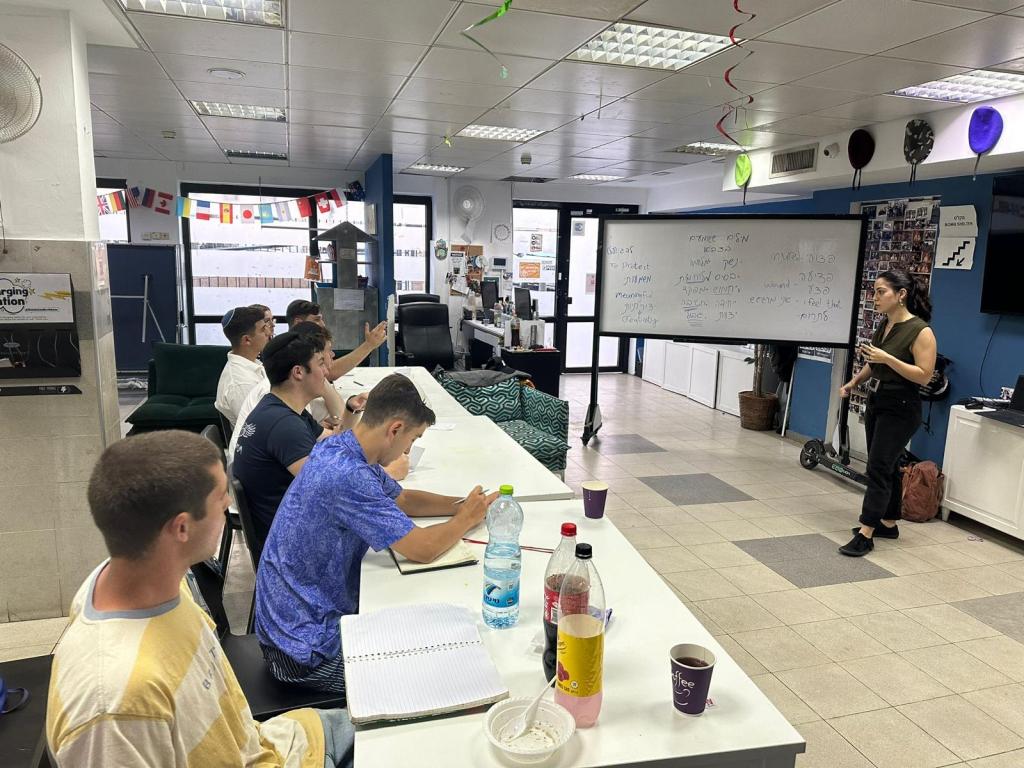
Ulpan Yehoshua, named after Yehoshua Eisenberg, is Tzevet Mikey’s new ulpan for learning spoken Hebrew that is relevant and critical to your success as a combat soldier in the IDF.
Effective communication skills are one of the most critical tools needed by combat soldiers. As many Lone Soldiers grew up outside of Israel, they are naturally disadvantaged as non-native Hebrew speakers. This disadvantage meets many Lone Soldiers before they even draft, as they attend different special forces unit tryouts. These Lone Soldiers are often the lead of the pack physically, mentally and socially, yet they meet great difficulty with the simple aspect of the easy 10 minute interview once finishing the tryout.
In memory of Yehoshua Eisenberg, we’ve set out to make learning and improving Hebrew communication skills more accessible to Lone Soldiers before they draft into the IDF. Ulpan Yehoshua has become an integral component of the pre-draft training that Tzevet Mikey provides to future Lone Soldiers and leaders of the Jewish communities around the world.
About Yehoshua
Joshua (Yehoshua) Eisenberg was born on December 13, 1946 in The Bronx, New York. Brought up in a strong Zionist family, he was an active member of the young Jews who defended religious Jews persecuted in the New York area. After serving in the US Marine Corp, he began University Studies. In the middle of his studies he decided to make Aliyah and left for Israel in 1970.
He became a chaver at Moshav Argaman in the Jordan Valley close to the border. In 1972 he enrolled in Ulpan Etzion, located in Bakah, to improve his Hebrew.
AT Ulpan Etzion he met Valerie Golde, another Olah from America. Following their studies at the Ulpan, both found work, Valerie working with the elderly and handicapped and Joshua worked in agriculture and forestry. They planned a wedding for October 23, 1973.
Early in 1973 Joshua drafted into the IDF as a Lone Soldier and served as a combat soldier in a Tank unit.
On October 6, 1973 Egyptians invaded Israel, crossing the Suez Canal, and the Syrians invaded Israel entering through the Golan Heights in the North. Joshua’s unit joined served under the command of General Ariel Sharon in the Sinai.
Back in Jerusalem Valerie decided to cancel the wedding, only to be surprised to receive a call from the IDF several days before the October 23. It seemed there had been a ceasefire in the Sinai and Joshua was being sent back to Jerusalem for the wedding. Valerie was assured that the IDF would take care of providing a Rabbi, Chuppah barer, and a Chazan. She was asked to gather up her friends to help her prepare some food, and choose an outdoor space for the ceremony.
Joshua showed up on their apartment doorstep two days before the wedding. Shortly thereafter they met with Rabbi Sherman at the IDF headquarters in Jerusalem and made final plans. In the meantime her friends were busy preparing a meal. A local baker contributed a two-foot long challah in their honor. There was a blackout in Jerusalem but with friends carrying candles, the ceremony went forward exactly as planned on October 23rd.
Joshua had a two-day honeymoon and then went back to his unit. The Yom Kippur War cost the lives of many Israeli soldiers, but the IDF succeeded in driving the Egyptian and Syrians back into their own territories.
Following a long period of reserve duty, Joshua moved back to the U.S. to complete his studies in Horticulture and with the hope of returning to Israel. But life intervened and as a married man the decision was made to temporarily remain in their new home in Michigan where he became a farm manager for a large commercial fruit operation.
After ten years in agriculture, he decided to return to University to earn a teaching certificate. For the next ten years he taught in a local Michigan public school before retiring in 2009.
Following Joshua’s passing from Parkinson’s Disease, Valerie decided to honor his memory by donating to Tzevet Mikey. He was a lone soldier at a time when the support for Lone Soldiers was non-existent. Fortunately, this is no longer the case as organizations such as Tzevet Mikey now exist and work towards providing Lone Soldiers with the critical tools they need in order to have a successful and meaningful service in the IDF.

 Tzevet Mikey - צוות מייקי